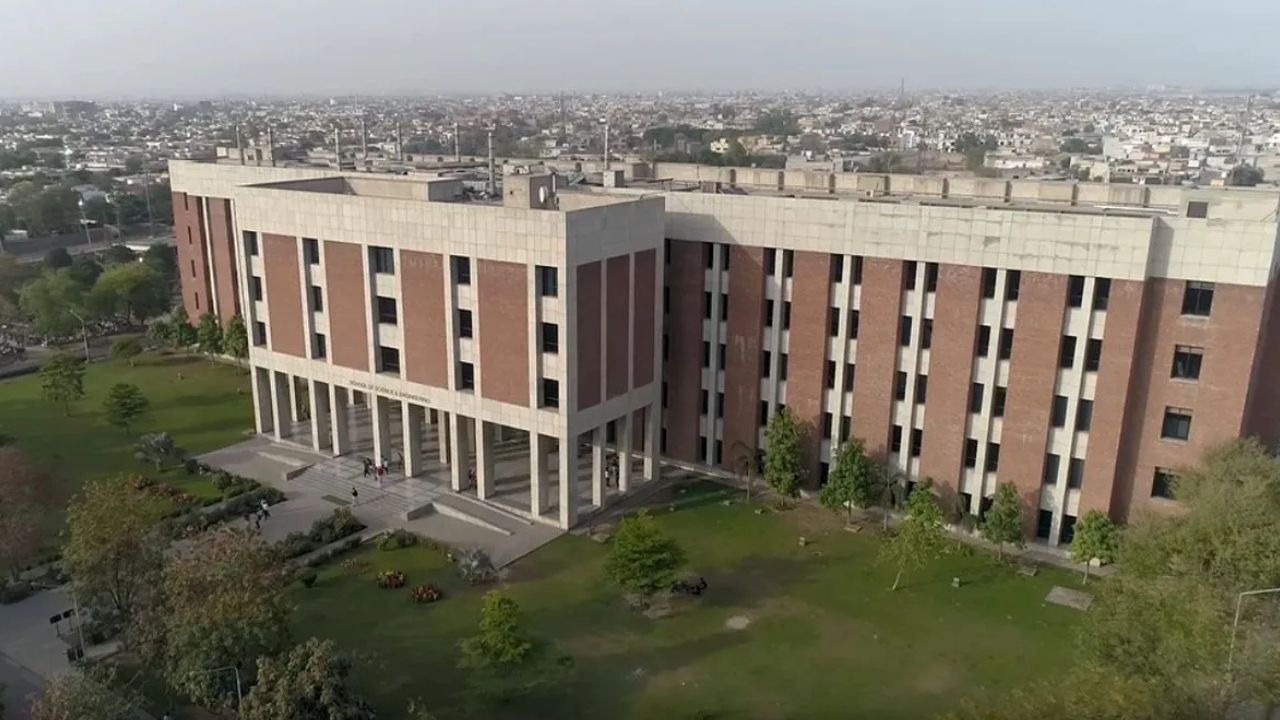


Bhagavad Gita Course in Pakistan: A Pakistani university has offered a Sanskrit course for the first time since partition. Following a positive response from the community, the Lahore University of Management Sciences (LUMS) expanded its three-month weekend workshop on the ancient language into a full four-credit university course.
According to a senior university official, everyone was welcome to attend the weekend session, including scholars, researchers, and students. He claimed that the Punjab University library in Pakistan possesses extensive but underutilized Sanskrit archives.
In a recent media interaction, Dr Ali Usman Qasmi, the director of the Gurmani Centre, said, “A significant collection of Sanskrit palm-leaf manuscripts was catalogued in the 1930s by scholar JCR Woolner, but no Pakistani academic has engaged with this collection since 1947. Only foreign researchers use it. Training scholars locally will change that.”
He also stated, “After we saw the response, we decided to introduce it as a proper university course. Although the number of students is still small, we hope it will increase over the next few years. Ideally, by spring 2027, we should be able to teach the language as a year-long course.”
Also Read: Is Your Daily Routine Secretly Making You Tired? Small Fixes That Work
Course on Bhagavad Gita and Mahabharata in Pakistan:
Qasmi stated that LUMS plans to offer courses on the Bhagavad Gita and Mahabharata after the program’s success. “Hopefully, this creates momentum… We might see Gita and Mahabharata experts from Pakistan in ten to fifteen years, Dr. Qasmi said.
According to media accounts, Dr. Shahid Rasheed, an Associate Professor of Sociology at the Forman Christian College in Lahore, is credited with starting this course. Since there were no indigenous textbooks available in the nation, Dr. Rasheed claimed to have learned Sanskrit online under the tutelage of Australian Indologist McComas Taylor and Cambridge Sanskrit expert Antonia Ruppel.
“Mankind can learn a great deal from classical languages. In a media interview, Dr. Rasheed said, “I studied Sanskrit after learning Arabic and Persian.” “The study of classical Sanskrit grammar takes nearly a year. I’m still researching it.
“Why shouldn’t we learn it, I ask them. It serves as the region’s unifying language. This was the village of the Sanskrit grammarian Panini. During the Indus Valley Civilization, a lot of writing was done here. Sanskrit is a cultural landmark, much like a mountain. We must take responsibility for it. It is not associated with any one faith; it is also ours,” Dr. Rasheed continued.
 Share
Share
 Aditya Dhar Responds To Hrithik Roshan’s Dhurandhar Review
 Mahesh Babu Remuneration for Varanasi Revealed: Highest Paid in Industry?