
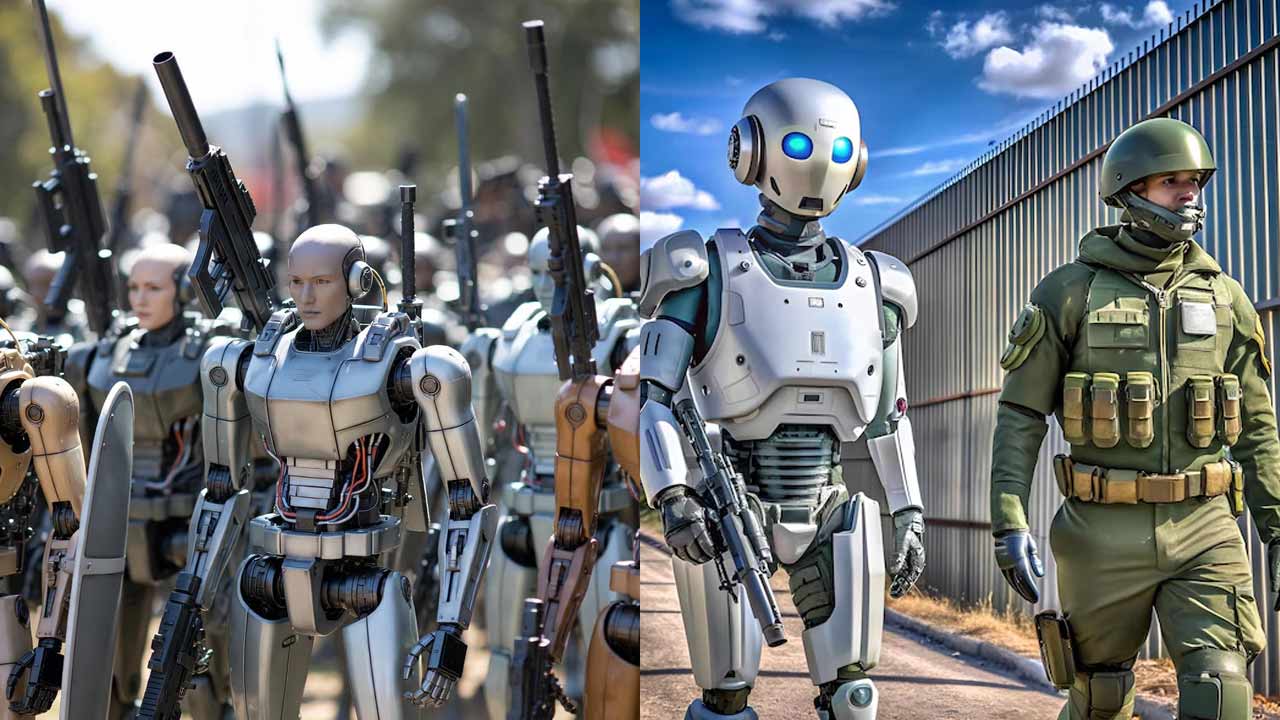


China will deploy humanoid robots for border security. This marks a major shift from human patrols. UBTech Robotics secured a $38 million contract for this project. The Walker S2 robots will guard the Guangxi border from December. They represent China’s push into advanced robotics for public security.
The Walker S2 robots will perform multiple duties. They will guide travelers at checkpoints. These robots will manage queue systems efficiently. They will conduct regular patrols along the border. The robots will also carry luggage and supplies. Furthermore, they will support various commercial services.
These robots will also work in manufacturing plants. They will inspect steel and copper production sites. Aluminum manufacturing facilities will also use them. This dual-use approach maximizes their utility. It shows China’s broad robotics strategy.
Walker S2 is 1.76 m tall and works in a 52° working range. The arms of the Walker S2 have 11 degrees of freedom and one arm can lift 15 kg. The Walker S2 can reach objects that are 1.8 m high and easily sit down and stand back up.
The Walker S2 has an autonomous hot-swappable battery system that can replace its battery in three minutes. The use of hot-swappable batteries allows the robot to operate continuously, 24 hours a day, with no human involvement. Dual batteries are used so that there is no downtime. This is important for border security applications.
The Walker S2 has a Brainnet 2.0 artificial intelligence (AI) framework that allows it to make autonomous decisions based on its understanding of its surroundings. The use of pure RGB binocular vision allows the robot to navigate and adapt to new environments. The Walker S2 can walk at a maximum speed of 7.2 km/h.
China is rapidly expanding the use of artificial intelligence and robotics. The government has put in place many different policies to support the growth of its robotics sector. Several airports have begun using robots to answer passenger questions, and government facilities are now using robots for many of their routine tasks. Some of the country’s largest events feature robot assistants and police departments in Shenzhen are using patrolling robots. Police departments in Shanghai and Chengdu have also begun rolling out similar robotic systems.
Query robots are currently in use at Hongzhou Xiaoshan International Airport, while Tianjin Police have deployed immigration robots during the summit of the Shanghai Cooperation Organisation. These multilingual robots were developed by Iben Intelligence. They could converse in several languages. This experience helped current border robots.
Also Read:In this Island Time Does Not Exist and People Sleep Anytime
 Share
Share
 Is Bhagyashri Borse Making Relationship With Ram Pothineni Official? Rumors Heat Up
 Top 8 Films People Watched Only Because of One Trending Scene