
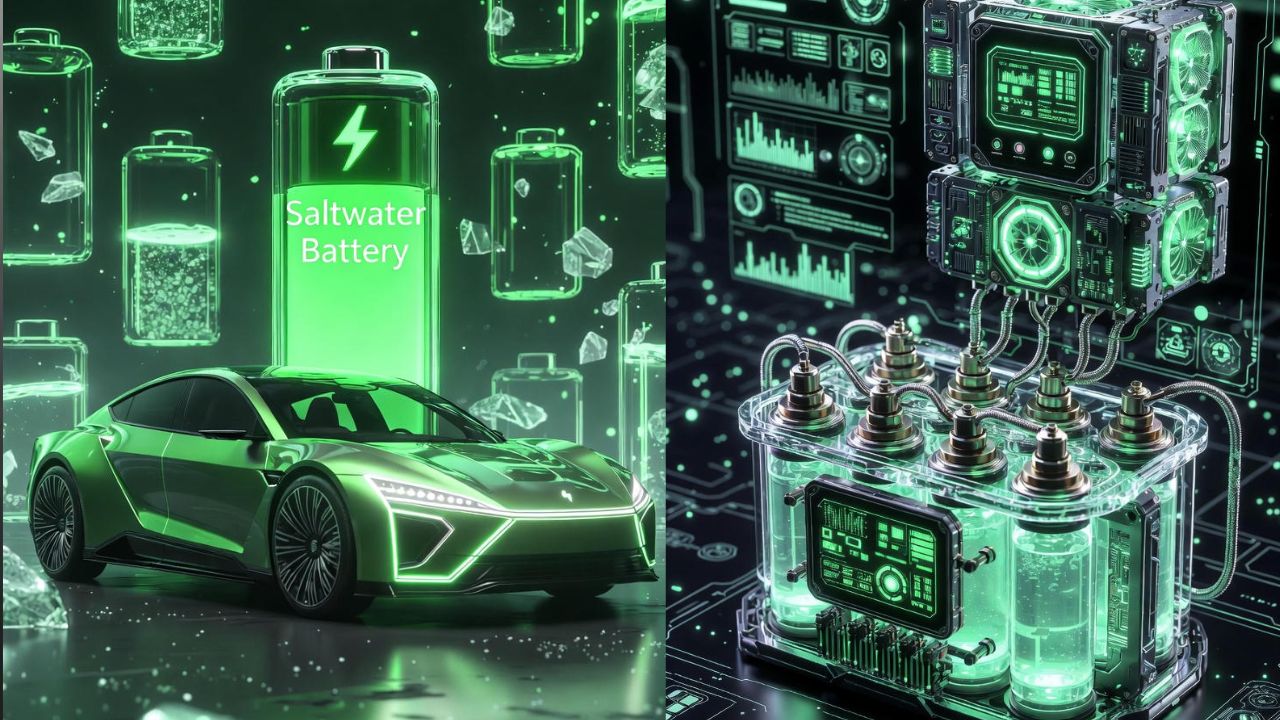


A new battery type is emerging for our future. It is called the saltwater battery. This technology moves beyond petrol and diesel. It also differs from traditional lithium-ion batteries. Saltwater batteries promise greater safety and lower cost.
Saltwater batteries use a simple core principle. Sodium ions move through a saltwater electrolyte. This movement happens between electrodes during charging. It also occurs during the discharging cycle. The process is fundamentally very stable and safe.
These batteries offer major safety benefits. They are completely non-flammable by design. Overcharging poses no fire or explosion risk. They avoid dangerous thermal runaway events. This makes them ideal for home and grid use.
They can be made from very inexpensive, commonly used materials. Sodium and salt can easily be found in every country. This is very different from the rare metals like Lithium and Cobalt we have to rely on. This allows for quicker and more ethical sourcing of materials. Therefore, we can also produce them much less expensively than our competitors.
Currently, they are being used in very specific applications. The best application is in home-based inverter systems. They also do well for energy storage for solar panel systems as well as micro-grids/back-up systems. Because they are so stable, they will also work well for storing products in a climate-controlled environment.
Currently, they are unable to replace electric vehicle batteries. The main reason for this is because the energy density of saltwater batteries is much lower. Saltwater batteries will not store as much energy per kilogram as Lithium-Ion batteries. This means they will be much larger and heavier than Lithium-Ion batteries and therefore will limit electric vehicle distance.
Research and develop of solid state sodium-based batteries are moving ahead in Australia and Europe. In China, they are currently testing sodium-ion batteries in scooters. There is a lot of focus on using sodium-ion batteries for grid-based energy storage applications. Commercialization is progressing very slowly as well.
The current sodium-ion battery technology has tremendous potential in India. It provides a green, economically viable alternative to imported batteries. Rural and off-grid regions would benefit greatly. In addition, if the energy density increases, this technology has the potential to become extremely popular.
Saltwater batteries are a strong contender. They will not dominate electric vehicles immediately. Their safety and cost will drive adoption elsewhere. They represent a crucial step in battery evolution. Sustainable energy storage needs such innovations.
Also Read: Can I-T Department Seize Cash At Home With an 84% Penalty?
 Share
Share
 Anaswara Rajan's Telugu Debut Film Champion: Release Date Unveiled
 Raja Saab Director Responds to Prabhas Fans About Earthquake News